HR software for Maldives resorts is a digital platform that manages the full employee lifecycle — records, attendance, leave, payroll, accommodation and expatriate visa administration — in one connected system. Unlike generic HR tools, resort-focused software is built around island operations, large expatriate workforces and Maldives immigration requirements, so HR teams manage people and compliance in the same place rather than across spreadsheets and disconnected apps.
Running HR for a Maldives resort is not the same as running HR for an office. Your people live where they work, often across departments and shifts, on a remote island that may be hours from Malé. A large share of your workforce is expatriate, which means employment administration sits alongside work permits, work visas and immigration deadlines. The right HR software has to understand that reality — not be configured to tolerate it.
This guide explains what resort HR software should do, why local compliance can’t be bolted on afterwards, and how to evaluate a platform for the way your resort actually operates.
Why is HR different in a Maldives resort?
HR in a Maldives resort is more operational than office HR because employees usually live on the property, work around the clock across multiple departments, and often include a large expatriate workforce subject to immigration requirements.
A single resort may run housekeeping, food and beverage, front office, engineering, security, recreation, finance and HR — each with its own rosters and shift patterns. On top of standard employee records and leave, HR frequently manages duty rosters, staff accommodation, employee movements between Malé and the island, arrival and transfer logistics, and expatriate documentation. The island setting adds distance: your corporate HR team may be in Malé while employees and resort management are on-island, so anything that depends on physically visiting an HR office becomes a bottleneck.
The practical consequence is that HR software for a resort has to do more than store names. It has to keep an island-based, multi-department, partly-expatriate workforce visible and manageable from anywhere.
What should you look for in HR software for a Maldives resort?
Look for a platform that covers the full employee lifecycle and the operational realities of hospitality — accommodation, rosters, expatriate visa tracking and mobile self-service — in one connected system rather than a stack of disconnected tools.
At a minimum, evaluate whether the software handles:
- Employee management and digital files — a single, searchable profile per employee instead of physical folders and spreadsheets
- Time, attendance and duty rosters — including biometric, GPS or geofenced attendance suited to on-island work
- Leave management built on Maldives rules — working-day entitlement, Friday exclusions and gazetted public holidays, not a generic calendar
- Payroll that fits local structures — service charge, pension, employee withholding tax and other components
- Accommodation management — room and bed allocation, occupancy, transfers and maintenance requests
- Expatriate and visa management — passports, work permits, work visas, expiry tracking and renewal workflows
- Mobile self-service — so line workers can check payslips, apply for leave and submit requests without visiting HR
- Reporting, analytics and role-based access — workforce visibility for management, with security appropriate to sensitive employee data
A useful test: count outcomes, not features. The question is not how many modules a product lists, but whether information created in one process (say, onboarding) flows into the others (payroll, accommodation, visa tracking) without re-entry.
Why does Maldives compliance need to be built in, not bolted on?
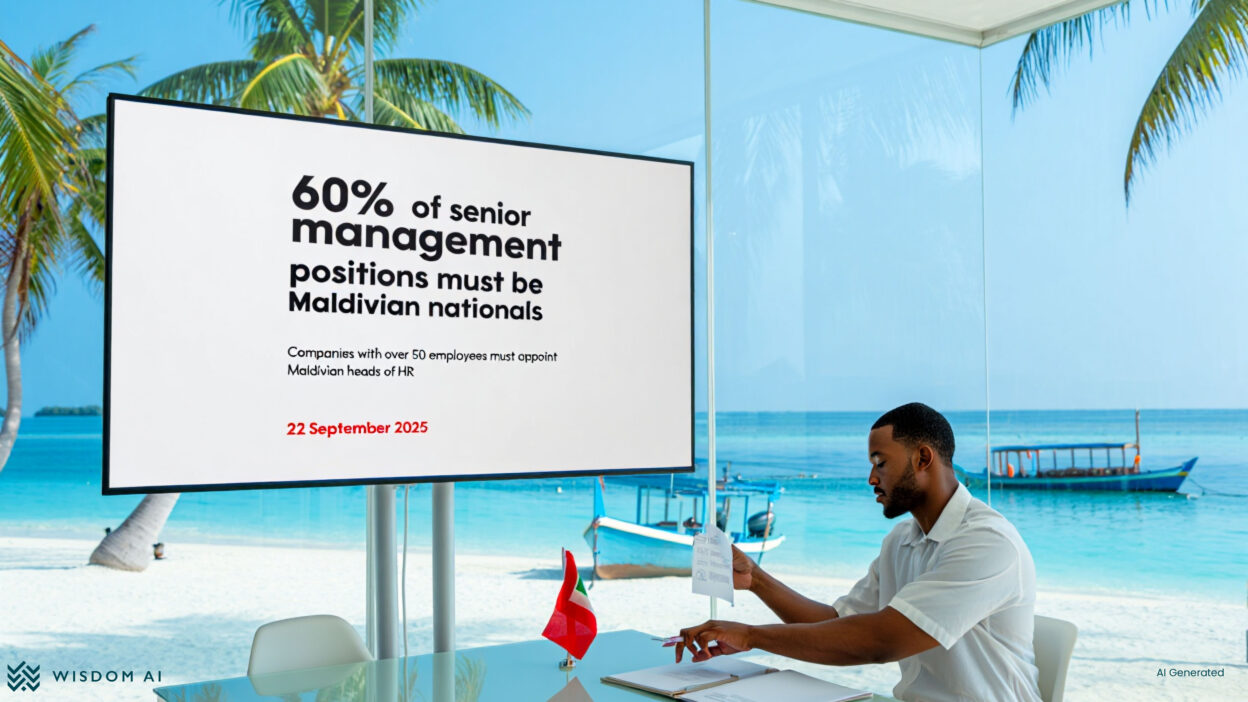
Maldives compliance needs to be native because expatriate employment is governed by both employment law and immigration rules, and getting either wrong carries real consequences. Software that treats these as an afterthought forces HR to track critical deadlines manually.
Two authorities matter here. The Labour Relations Authority (LRA) confirms that the Employment Act applies to both Maldivian and expatriate employees, and expatriate employment is further governed by the Regulation on Employment of Expatriates in the Maldives (2023/R-111). Maldives Immigration operates a digital work-visa process through the Xpat Online System, and its current guidance indicates that a newly arriving expatriate must obtain the Work e-Visa within 15 days of arrival on a valid Work Permit.
A distinction that trips up generic systems: a Work Permit and a Work Visa are not the same thing. The Work Permit relates to authorization to work; the Work Visa (now issued as an e-Visa) relates to permission to reside and work, and its validity is tied to the approved Work Permit. HR software built for the Maldives should track both against each employee and alert you before either expires — because discovering an expired visa after the fact is a compliance problem, not an admin one.
Because immigration procedures can change, employers should always verify current requirements directly with Maldives Immigration and the LRA. Good software complements the official systems by keeping your internal records, documents and upcoming actions organized — it does not replace them.
HRMS, HR operating system, or HRVMS — what’s the difference?
An HRMS centralizes core HR processes; an HR operating system connects those processes, data and workflows around a single employee record; and an HRVMS extends that further to include expatriate and visa management — the layer that matters most for Maldives resorts.
| Term | What it primarily does | Best fit |
|---|---|---|
| HRMS (HR Management System) | Employee records, attendance, leave, payroll, performance | Organizations with mostly local staff and standard admin |
| HR operating system | Connects HR data, workflows, automation and decision support across the lifecycle | Larger or more complex workforces needing integration |
| HRVMS (HR & Visa Management System) | Everything above, plus work permits, work visas, passports, expiry tracking and immigration workflows | Employers with significant expatriate workforces — including Maldives resorts |
For a resort employing a large expatriate workforce, the HRVMS approach is the meaningful one: it keeps an employee’s HR record and their immigration status in the same place, so HR can see contract dates, work-permit status and work-visa validity together instead of switching between systems.
How does AI help with resort HR?
AI helps resort HR by turning workforce data into answers — letting HR, managers and executives ask plain-language questions and get instant responses, and by surfacing issues such as approaching visa expiries or budget overruns before someone has to go looking.
Instead of building a report to find out who is absent today, which work permits expire next month, or which department is trending over its payroll budget, an AI assistant connected to your HR data can answer directly. The value comes from that connection to your organization’s real data and permissions — not from a generic chatbot.
One principle should guide any AI-in-HR decision: AI can assist HR decisions, but accountability remains with people. For sensitive matters — employee relations, disciplinary action, and anything with legal weight — AI should support human judgment, not replace it. When evaluating an “AI-powered” HR platform, ask specifically what the AI does, rather than relying on the label.
How does Wisdom AI approach HR software for Maldives resorts?
Wisdom AI is an AI-powered HR platform built specifically for Maldives resort operations, bringing HR, payroll, visa management, accommodation, performance and more into one system across web and mobile — with Maldives compliance logic built into the core rather than configured on afterwards.
In practice that means leave accrual on working-day rules, Friday exclusions and gazetted holidays, work permit and work visa expiry tracking with alerts, payroll that handles pension, employee withholding tax and service charge, and staff accommodation management — all connected to a single employee record. An AI workforce assistant is available across modules for HR, GMs, Finance and HODs, and line workers get mobile self-service for payslips, leave balances and requests. The platform is designed to automate a large share of repetitive HR administration — up to around 80% in applicable processes, depending on how a resort configures its workflows — so HR teams spend less time on paperwork and more on people.
The aim is straightforward: move a resort HR department from managing records to running operations, without leaving compliance to chance.
Frequently asked questions
What is the best HR software for a Maldives resort? There is no single best product for every resort. The right choice depends on workforce size, number of departments, the size of the expatriate workforce, payroll structure, accommodation arrangements and reporting needs. Evaluate any platform on how well it handles island-based workforce management and expatriate administration — not just conventional HR features.
Can HR software manage work permits and work visas? Yes. Platforms designed for expatriate-heavy workforces can maintain passport, work permit and work visa records, track expiry dates and run renewal workflows. In the Maldives, the official application process is still completed through Maldives Immigration’s Xpat Online System; internal HR software complements it by organizing records and deadlines.
Is HR software suitable for large resorts with hundreds of employees? Yes. Larger resorts benefit most from centralization, because managing hundreds of employees across departments, shifts, accommodation and expatriate requirements through spreadsheets becomes error-prone. Implementation should be configured around the resort’s structure, permissions and reporting needs.
Do resort employees need a mobile app? Mobile access is especially valuable in resorts, where employees work across departments and locations rather than at a desk. A mobile app lets staff check payslips and leave balances, submit requests and receive communication without visiting the HR office.
Does HR software replace official Maldives government systems? No. HR software supports internal record-keeping, reminders and workflows, but Maldives Immigration remains the authoritative source for work-visa procedures, and the Labour Relations Authority maintains the relevant employment legislation. Employers should verify current requirements with those authorities.
Ready to see it for your resort?
Wisdom AI is the HR platform built for the way Maldives resorts actually operate. To see how it fits your property, request a demo or contact the team at hello@thewisdom.ai / +960 9226622 / 3310001.
You already run a five-star resort. Your HR systems should too.